Friday, 25 February 2022

Harrison's Third Heart Surgery (2000)

*Please note that there are photographs of Harrison in intensive care in this post. I don’t take photographs of him when he’s unconscious or unstable. However, I’m aware that some of the photos with Harrison having therapeutic oxygen /  non-invasive ventilation support, and with various lines going into his body may upset some people.*


Harrison spent his time on the ward confined to his highchair because his tube feeds had to be virtually trickled into him . His body was struggling to keep him going, and feeding and digestion was just another stress on his system. At least we had the Sydney Olympics to keep us all occupied! We rarely made it outside the hospital to enjoy the summer sun because Harrison was not well enough.

He painted this abstract picture a couple of days before his third surgery. It's proudly displayed at the top of our stairs at home:


Harrison had to wait until October 9th for this surgery. His surgeon had gone away for a foreign conference and the intensive care unit was blocked with long-staying cases. Harrison wasn't in the best shape and the complex surgery meant that there was a 20% chance that he wouldn't survive it. I had to sign the consent form......

Harrison had a major bleed towards the end of the surgery; the surgical team experienced great difficulty in tracing, and eventually stemming the bleed. The surgeons had closed off more surplus arteries they found, and had fitted a homografted pulmonary artery from the lower end of his right ventricle, over the heart, and reconnected to the junction of the left and right pulmonary arteries. The large VSD Harrison had, was patched. His right pulmonary artery was widened. The homograft would have depressed Harrison's right-sided aortic arch onto his trachea and oesophagus, so the surgeons stitched the homograft onto the chest wall. They had not performed this step before in similar operations. One large surplus artery remained which the surgeons physically could not reach safely. 

Harrison recovered fairly well initially, but after several days on a ventilator, his progress stalled, and the intensive care team couldn't deduce why. Five days post-surgery, Harrison was diagnosed with parainfluenza and was isolated. This could often be fatal. He spent a month in intensive care with three weeks being sedated and ventilated to give his body time to recover from the virus.
We spent as much time as we could next to his bedside just talking and reading to him, holding his hand and reassuring him. However, we obviously needed breaks to eat and rest so that we could support him, although I mostly kept going on adrenaline to minimise my time away from Harrison. 
During our absence and to give Harrison a well-deserved break from the monotony of our voices, we played his favourite video to him via a Walkman (hands up if you remember them!) and headphones. Harrison had developed an obsession for a particular Tweenies video – “Tweenies Song time”. He would watch it on repeat day after day and it brought him much joy. He even managed to monopolise the single television in the bay he shared with 5 other patients whilst waiting for this surgery! 
Knowing Harrison’s past history of recovery from surgeries and procedures, I’d anticipated that he may not be able to watch his video for a while and had recorded it onto a cassette tape prior to his untimely re-admission. It was something that I had decided to do during his intensive care stay following his first surgery. At that time, I’d repeatedly read some of his favourite books to him but wanted to work out a way of providing a bit more variety whilst he was unable to interact. I hoped that he may appreciate hearing familiar, favourite songs. 

An added benefit of playing tapes through headphones to Harrison was that they helped to block out the sounds of the intensive care unit because although he was sedated, he was still aware. During this hospital admission a close friend sent him a Thomas the Tank Engine story tape too. Thomas was another favourite of his which we then alternated with the Tweenies.

Harrison was extubated on Bernard’s 30th birthday. What better birthday present could you ask for?! Although Harrison was still quite drowsy from all the sedation, being off the ventilator and just on non-invasive ventilation was a huge boost for both Bernard and I. So much so, that we both felt able to celebrate the occasion by going out for a meal with Bernard’s eldest sister and her family who’d very kindly came up to share Bernard’s special day with him. Until that day, we had only eaten in the hospital restaurant and coffee shop, not wanting to be more than a couple of minutes away from the children's ward  or Paediatric Intensive Care Unit (PICU).


Spending time without supplementary oxygen was initially very tiring for Harrison.
He already had poor muscle tone due to 22qDS but had lost even more
and needed extra support to sit up.

As Harrison recovered in intensive care, he was given some simple puzzles to do to see whether there had been any lasting impact on his brain.


Forget the baby puzzles; he wanted proper toys
(aka dad's Blackberry!)


Being such a long time in PICU the staff became very familiar with him and decided that he should start doing some work and one nurse in particular liked Harrison to help her log notes about his care onto their computer system!


He was treated like royalty, in that a television was wheeled in for him and as you can see from the photograph below, he was glad to be able to see and catch up on his favourite television programme of the time which was ‘Who Wants to be a Millionaire?’ A very strange choice for a 2 ½ year old but he even had the quiz book in his toy box!


It doesn't matter how poorly you are, 
you still have to have your hair washed!!


When he was finally well enough, Harrison spent another three weeks recovering on the ward. His gut motility had stopped working so he ended up on Total parenteral nutrition (TPN). He'd also been fitted with a gastrostomy (a more permanent replacement for the nasogastric feeding tube) a few months previously which was vital in helping his recovery back to 'eating' normally for him. You'll read in other blog posts how Harrison's eating always takes a hit post surgery; he fancies food but just can't eat it. 

It took his stomach a couple of weeks before he could digest food properly, and because he had spent several weeks in bed, he could no longer sit up or walk unaided. 


He was so impressed with his Happy Meal - not!
We couldn't tempt him to eat more than a bite of one nugget. 


The physiotherapy team brought the special armchair (pictured above) to the ward for Harrison to use. It was completely supportive and could more or less mould to Harrison's body shape thus keeping him in a better seating position. If we sat him in his high chair, he would just end up falling to one side because he couldn't support himself any longer. As you can see from the photograph he spent time lying down in his bed playing with his toys because he was no longer strong enough to sit up in bed.


Harrison was admitted to The Royal Brompton in the height of summer and discharged back to our local hospital for a few more nights in December. 


I’d not experienced an admission where we spanned two seasons before. However, we were home in time for Christmas!


After four months of intensive occupational and physiotherapy at home, Harrison was able to walk unaided again. 


Things were going well, but then he started catching recurrent infections again, so is now taking regular prophylactic antibiotics.


Glossary:

Extubated: when a doctor or nurse removes the ventilator tube that was helping a patient to breathe.

Gastrostomy: a tube which is inserted through the abdominal wall into the stomach. It is usually used to give nutrition to an individual unable to consume sufficient calories by mouth.

Non-invasive ventilation (NIV): uses a machine to help with your breathing. It's a bedside machine, connected to tubes and a mask, which is worn over your nose and mouth. As well as helping with your breathing, it supports your lungs, giving your body the chance to heal .

Prophylactic antibiotics: are antibiotics taken to prevent infection. Prophylactic antibiotics decrease the risk of an individual developing infections that can sometimes be life-threatening. They can also stop a chronic or recurrent infection from coming back. 

Total parenteral nutrition (TPN): is a method of feeding that bypasses the gastrointestinal tract. A special formula given through a vein provides most of the nutrients the body needs. The method is used when someone can't or shouldn't receive feedings or fluids by mouth.

Monday, 21 February 2022

Harrison's Second Heart Surgery (2000)

Harrison had a frustrating habit of becoming unwell a few days before or even the night before a scheduled surgery. It’s a surreal feeling when you‘re waiting for your child to deteriorate sufficiently to qualify for the next stage of surgery to improve their quality of life. Until you receive the date, you try to carry on with your usual routine, doing your best to balance developmental and socialisation opportunities with protecting them from infections and viruses which invariably lead to further hospital stays. 

Just before my second surgery. My uncle took full advantage
of my reduced mobility by introducing me to video games aged two! 


The first date scheduled for Harrison’s second heart surgery was in June 2000. This was the first time that we became aware that rather than summer being a healthier time of year for Harrison, it seemed this was when he was most prone to develop pneumonias. It was a pattern that presented for several years throughout his childhood. Another round of antibiotics and time to recover, then another date was diarised. The second time, we made it to The Royal Brompton and during the pre-op checks the night before surgery, Harrison spiked a high temperature. Further symptoms swiftly developed so he was sent home again, this time with a plea from the surgeon to Harrison’s local consultant paediatrician, to get him well enough for surgery!

It was not only incredibly frustrating for the surgeon, but it was difficult emotionally for us too. As soon as the surgery date has been confirmed (we usually have a couple of weeks’ notice), I can’t help but start thinking about what might be. It’s really difficult to explain; I feel relief and optimism that Harrison’s being given the chance of better health but at the same time, I think about possible complications that might arise during or post-surgery. With so many surgeries behind us now, I have too many experiences to draw on! From the time the date for surgery is confirmed until he’s safely breathing on his own again, I’m functioning on autopilot; feeling empty / numb. So, you can imagine how stressful it is when surgeries are cancelled for any reason and we’re back to being in limbo not able to resume our life because we need to keep a very vulnerable child free from infection in anticipation of an imminent surgery date. 

Anyway, after a few false starts, Harrison’s second surgery (a right-sided unifocalisation of the multiple collateral arteries) went ahead in August 2000. 

How do Bernard and I fill our time whilst we're waiting for Harrison to return? Our routine is always the same. He’s more often than not first (or the only patient) on the surgery / procedure list for the day. 
We never eat before Harrison is taken to the anaesthetic room. It doesn't seem fair when he's not been able to eat anything since midnight the night before. We established a routine from the first diagnostic cardiac catheter when he was about 8 months old. 
After leaving Harrison anaesthetised, we eat breakfast in silence in the hospital restaurant. Next we amble (no need to rush; we've usually got at least eight hours to fill) across Albert Bridge to Battersea Park and sit on our usual bench backing onto the Thames. We try to busy ourselves by watching the world go by (land, water and air) whilst trying not to look at our watches more than 100 times an hour! We barely speak a word to each other but when we do, it’s never to make any post-surgery plans. At lunchtime, we head back across the river to get a main meal. Not because we're hungry, but in case we don't get a chance to eat later because we want to sit next to Harrison's bed. 

Battersea Park or the Peter Jones department store at Sloane Square (if it's raining) are the furthest that I’m willing to be away from the hospital when Harrison is having surgery. They’re both approximately 15 minutes’ walk away in different directions but close enough to be able to run back to the hospital in a few minutes. After lunch, we wander back in the general direction of the hospital pausing for another couple of hours in St Luke’s Gardens. It's another tranquil spot which happens to be conveniently located directly opposite the hospital! 

St. Luke's Gardens.
The building in the background is the Sydney Street wing
of The Royal Brompton Hospital.

When we can bear it no longer, we saunter into the hospital failing miserably at pretending that we haven't a care in the world! We always return to the hospital far too early but we’re forever optimistic that Harrison’s surgeries and procedures may be without complications. The only places for us to hang around and wait in the hospital are the parent room or the coffee shop. The bed space that Harrison had previously occupied on the ward would have been reallocated to another patient. Even if the pager we’d been loaned and our mobile phones haven’t indicated that it’s time, we impatiently head to the intensive care unit to ensure that we're there at the estimated time for Harrison’s return and to see if we can catch a glimpse of him on his way back from the operating theatre. 

We follow the same routine every time……

Thankfully, for this second surgery, Harrison didn’t follow his usual path and recovered very quickly. He was extubated the following morning and discharged from the general ward eight days after the surgery. This was the first of only two out of five textbook heart surgery recoveries for Harrison, so he took everybody by surprise!

He was sent home still requiring oxygen, but it was hoped that his need would diminish rapidly soon after. 

Completely spoilt by my grandparents
but very handy when you're too tired to walk!

This was not to be the case. He became more and more irritable, and soon needed more oxygen than ever before. To ease his breathing overnight, we raised the head end of his bed. He still sleeps on an inclined mattress today. 
He was extremely breathless, and couldn’t walk two metres without his oxygen levels in his blood dropping to low 40%. This was while he was being given THREE litres of oxygen per minute. This amount gave Harrison severe headaches, and the extreme breathlessness caused vomiting and weight loss. He was sent back to the Brompton only two weeks after going home. The Brompton staff decided that Harrison should remain with them until he could undergo a total correction for his heart condition. 

Monday, 14 February 2022

Heart Awareness Month / Harrison's First Heart Surgery (1999)

Once again, I’m introducing a temporary break in Harrison’s story. 

This image popped up on my Facebook timeline
but I can't find it again to attribute the creator.

February is heart awareness month, so it seems appropriate for me to share the trials and tribulations of Harrison’s five major heart surgeries to date. 

As you can see from the graphic above, approximately one in 100 babies are born with a congenital heart defect (also known as congenital heart disease) (CHD). Not all heart conditions are due to an underlying genetic condition. Congenital heart disease is a general term for a range of birth defects that affect the normal way the heart works. The term "congenital" means the condition is present from birth.


For individuals with 22q11.2 deletion syndrome approximately 70% of them will also have a heart condition. As with other aspects of the condition, these will vary in severity.  Unfortunately Harrison ended up on the more severe end of the scale but we view ourselves as fortunate because he's less affected by other symptoms of 22q11.2 deletion syndrome.

Twenty three years ago I didn’t document each day of the heart surgeries, however the major events (good and bad!) of each surgery will be etched on my mind forever. 

Harrison will require ongoing surgeries throughout his life until such time that a more permanent solution can be developed for his replacement parts!


In addition to these surgeries, Harrison’s had countless cardiac catheterisations under general anaesthetic to widen and / or stent his narrowed arteries and diagnostic procedures to accurately check pressures in various parts of his heart, in preparation for the surgeries.


Before I recount his first surgery, I want to show you what the surgeons were dealing with. Here's a picture of normal heart courtesy of The Brompton Fountain:


To recap, the diagnosis of Harrison's heart condition at four months of age was Tetralogy of Fallot's with pulmonary atresia, ventricular septal defect, Major Aorto-Pulmonary Collateral Arteries (MAPCAs), left-sided aortic arch. Pictures below courtesy of The Children's Heart Clinic at Children's Minnesota


A rather blurry normal heart from the same source 
to show the comparison with Harrison's heart

Harrison's pulmonary artery was completely blocked which meant that blood couldn't get to his lungs for oxygenation. He had a hole between the two pumping chambers of his heart which meant that the blood to and from the lungs was mixing, hence the purple colour in the first diagram. To help out, several extra arteries had grown to try and get blood to his lungs. Very helpful in keeping him alive in the short term but not effective long term. They make the corrective surgery more complex. Harrison was due three surgeries to complete the 'repair'. I've put repair in quotes because as you'll realise, this isn't a one time fix. Tweaks are required lifelong to keep things working as well as possible. Harrison will never have a 'normal' heart but it can function adequately with surgical interventions and medicinal support.


The day before admission to The Royal Brompton for surgery


Harrison underwent his first heart surgery (a left-sided unifocalisation of the multiple collateral arteries and the addition of a Blalock shunt) at the Royal Brompton on 8th April 1999. He was 15 months old. A unifocalisation joins the collateral arteries into the main pulmonary artery and the Blalock shunt provides an additional, temporary route to get blood to the lungs.

Below is a link to a fantastic animated video not only explaining the process of unifocalisation (and letting you have a go at a virtual repair) but it also explains pulmonary atresia and covers the rest of the stages in Harrison's subsequent surgeries. It is presented as a single surgery but in Harrison's case the surgeon decided that each stage should be performed separately in order to provide the safest outcome for Harrison:


It may take a few seconds for the page to set up, but it really is worth watching all three sections of the video if you'd like a better understanding of Harrison's heart condition and the surgeries.

The Blalock shunt part of Harrison's first surgery isn't discussed in the video so I've created a separate page using a PDF resource from Children's Minnesota to explain it. You can find the page on the top left section of my blog or follow this link: blalock-taussig-shunt-procedure


To access the area necessary for the procedure, the surgeon made the incision around Harrison's left shoulder blade.

Harrison had complications after the 8 hour surgery. They started as soon as he was returned to the Paediatric Intensive Care Unit (PICU). He was difficult to ventilate because his lungs were stiff and he was trying to fight the ventilator, despite being sedated. In the end, he had to be given a drug to paralyse him to enable the team looking after him to gain control. They had already started to realise that Harrison doesn't like to follow the medical textbooks. He likes to do things his way which in this case meant that our 15 month old baby required an adult dose (or in the intensivist's words, enough medication "to slug an elephant"!) Whilst ventilated, the respiratory team were called in to perform a couple of bronchoscopies to try and identify why he was having difficulties. 
Even while sedated, Harrison had worked out a way to communicate with us how he was feeling. We were at his bedside for as many hours as possible each day; I was usually the first parent in the unit in the morning and the last to leave at night. I spent the majority of the time just sitting holding his hand and talking to him. To let us know that he was upset or uncomfortable, Harrison used to squeeze our fingernails between his finger and thumb. It's incredibly painful and I have no idea how he knew to do this or had the strength to inflict such pain! It was a small price for us to pay, given how much he was probably suffering! He continues to do this to this day whenever he's unwell and especially during hospital stays. 

Six days post surgery, he finally appeared recovered enough to be weaned from the ventilator. This is a fine balancing act in withdrawing the sedation and allowing the patient to wake up sufficiently to take over their own breathing again before the tube is removed. Not easy when the patient is aware of the uncomfortable foreign body down their throat and does their best to remove it themselves. Quick reactions from all onlookers were required to prevent Harrison from extubating himself too soon!

The ventilator tube was removed and the nurse looking after Harrison decided that he deserved a long overdue cuddle with me. To give Harrison some privacy and to hide the other patients from Harrison's view (so as not to scare him with all the equipment now he was more awake), the nurse pulled the curtain around Harrison's bed space. She busied herself outside supporting the other nurses with their patients. In the intensive care units (paediatric and adult) the nursing ratio is 1:1 with every patient having at least one nurse devoted to their care. In some instances, patients require more than one nurse to look after them. There's always at least one floating nurse who can support with running bloods for testing, fetching equipment,  drawing up medication etc.

I was uncomfortable being hidden from view and left in complete charge of a drowsy Harrison who was clearly not in any hurry to wake up properly. I was watching him like a hawk and could see that his efforts to breathe were becoming less frequent and more shallow. I called the nurse back but she assured me that he was doing as well as expected. I was far from convinced and felt that there was something wrong. 
Fate intervened just at the right time (although I'd have been much happier to have seen her much earlier!) when a senior physiotherapist turned up to give the patients in our bay, chest physio. It's vital that the patients are helped to clear any secretions that lay on their chests, not only to improve their breathing and prevent infections but the secretions can also block the ventilator tube. 
By the time of Harrison's first surgery, he was already known to many of the Brompton staff due to several stays on their children's ward. The physio was one of those who knew him. I can't tell you the relief I felt when she scooped him out of my arms, returned him to the bed and called for help. By now, Harrison was barely breathing. 
Unfortunate timing, but Bernard's parents had just turned up to visit and I noticed them looking through the window. Bernard was with them and distracted them whilst Harrison was re-ventilated. 

Following another three days of ventilator support, the second extubation was successful and Harrison was carefully watched to ensure that he didn't deteriorate again. That evening he was moved into the High Dependency Unit where there was one nurse to every two patients to ensure further recovery before being discharged back to the busy ward. The regime of chest physiotherapy continued and was supported by one of the nurses. She was over enthusiastic in her approach to clearing Harrison's lungs by whacking him on his back over his wound site. It was covered by a dressing but every time he was hit, Harrison screamed in pain and tears streamed down his face. After witnessing this traumatic event a couple of times we had to ask her to stop. Our baby was incredibly brave and resilient but once again something wasn't right. Chest physiotherapy can look quite brutal sometimes but it shouldn't make the patient scream in pain. When the dressing was removed, it revealed an infected wound site. Unfortunately, this incision didn't heal as it should, and Harrison is left with a thick lumpy scar. 

This was a couple of months after he arrived home again.
You can see how red and thick the scar under his left shoulder blade is

The corresponding scar on the opposite side under his right shoulder blade (later from surgery no. 2) is just a thin line and barely visible. Thankfully, Harrison has never been bothered by the look of his scars (not that he can see the two on his back!)


The smiles are back and he's well on the road to post surgery recovery


He left hospital three weeks later.

The day after he arrived home


Glossary:

Bronchoscopy: A Bronchoscopy is a procedure in which the doctor passes a thin tube  through the nose, down the windpipe through the voice box and into the bronchial tubes of the lungs. This procedure is used to find the cause of a lung problem. It can detect tumors, signs of infection, excess mucus in the airways, bleeding, or blockages in the lungs. It also can allow the doctor to take samples of mucus or tissue for other laboratory tests, as well as to insert airway stents, or small tubes, to keep the airway open to treat some lung problems.

Cardiac catheterisation: A cardiac catheterisation is an invasive diagnostic procedure that provides important information about the structure and function of the heart. It usually involves taking X-rays of the heart's arteries. The resulting images can be used to help plan future treatments and carry out certain procedures (some of which used to be performed via open heart surgery).
During the procedure a long, thin, flexible tube called a catheter is inserted into a blood vessel into the groin or arm. Using X-ray images as a guide, the tip of the catheter is passed up to the heart and coronary arteries.
A special type of dye is injected through the catheter and clearly highlights any blood vessels that are narrowed or blocked. (Source – NHS)

Unifocalisation: The objective of a unifocalisation procedure is to create a single source of blood flow to each lung by combining the MAPCAs.


Thursday, 3 February 2022

His Story - 8 months - RSV and oxygen dependency


When he was 8 months old, Harrison contracted RSV (Bronchiolitis) which threatened his life. He had literally just been discharged from hospital following yet another stay for a diarrhoea and vomiting bug. The nurse came into our cubicle to say that we could take Harrison home but my instinct was that he wasn't quite right. Clinically, all of his observations were as expected so there was no reason for him to stay. 

We arrived home and I carried Harrison into the lounge. I sat on the floor with him to take off his coat and felt him go limp in my arms. At the same time, his eyes rolled back into his head. Bernard was outside just getting the bags out of the car. I shouted to him. We left the bags in the boot, locked the front door and headed straight back to the hospital with me frantically calling the ward on the way.

The doctors had no idea how Harrison could have contracted the virus and could only conclude that it was from literally being pushed through air containing the virus in the hospital or street. 

This was one of the scariest times for me; watching Harrison’s increasing struggle to breathe despite every intervention that our local hospital could administer. He was on steroids, intravenous antibiotics and virtually constant nebulisers but continued to deteriorate over the next few days. In the end a retrieval team from Guy’s and St Thomas’ came and collected him for a stay in their intensive care unit. I think this was the most helpless I've felt throughout his life so far. We couldn’t travel with Harrison in the ambulance due to the number of staff going with him in case he needed lifesaving treatment en route. They told us not to follow the ambulance directly so we left our local hospital a while after them. Bernard’s brother drove us up to London but given the congestion starting on the outskirts of London, we caught up with the ambulance. From the back seat of the car, I was silently willing the traffic to move out of the way so that the ambulance could get through. I couldn't believe the way some of the drivers used the ambulance as a tool to help them by pass the jams too! We arrived in Guy's hospital forecourt at more or less the same time as the ambulance. 
Accommodation was organised for us in the Ronald McDonald house close to the hospital and after a few days in intensive care, Harrison had improved enough to continue the intense hourly nebuliser regime on the ward. He was given a side room and as he was no longer in intensive care, we had to relinquish our room in the Ronald McDonald house. I moved into Harrison's side room and Bernard travelled up to visit each day. I didn't set foot outside the room until Harrison was transferred back to our local hospital a couple of weeks later. He remained an inpatient to continue his recovery and in an attempt to wean him from the oxygen that he’d become dependant on.

After another month in hospital Harrison had recovered enough to be discharged, but the RSV had damaged his lungs. It was clear that he would be requiring additional oxygen for some time. He was put onto continuous oxygen via nasal cannulae and stayed on this for 24 hours a day until November 2000. 

He loved his new winter hat!


We had an oxygen concentrator installed in our house with taps and tubing to allow Harrison to mobilise throughout. The concentrator was powered by electricity so we also had to store two large stand-alone oxygen cylinders in our garage for back up in case of power cuts. We needed to take them with us to provide Harrison’s additional oxygen if we wanted to go on a short break or an overnight stay. The two large cylinders were sufficient for an overnight stay but not for a short break. Given Harrison's track record for hospitalisation, we rarely strayed far from home. However, when he was 19 months old, we took him to Disneyland Paris where we needed four of these large cylinders for when we were in our hotel room and eight smaller ones for going around the park and travelling to and from Paris. Thankfully, we were only there for two nights because the cylinders filled our people carrier and we needed to use a roof box for our suitcase and Harrison’s pushchair!


The bag carrying the oxygen cylinder can be seen poking out the back of the pushchair.


Feed pump in the grey bag hanging from the pushchair handle.
Despite the tubes he still attracted the pretty girls!


Alongside the two large oxygen cylinders that were permanently in our garage, we had between six and twelve small portable oxygen cylinders delivered to our house each week. The purpose of these was to enable us to go out, not just for all the medical and therapy appointments but for pleasure too! Depending how ‘well’ Harrison was, one portable cylinder would last him from half an hour to four hours of continuous flow. On a ‘well’ day, if we’d planned a trip out, we would take three portable cylinders with us, which would in theory last for twelve hours. We had to allow for any unexpected traffic delays or a rare malfunction of a cylinder where we could either not undo the seal, or it was already empty.

Carrying around these weighty cylinders and a poorly toddler put a lot of strain on my body. Even now, I still suffer from hip pain on the side where I used to carry both Harrison and a cylinder simultaneously. I've also developed lower back problems.
After a while we were able to switch to liquid oxygen which made a big difference in several ways. Firstly, we didn’t need the concentrator, so no longer had to rely on electricity to power Harrison’s indoor oxygen supply at home. However, we kept the large cylinders in case we wanted to go away anywhere because the main liquid oxygen tank wasn’t portable. We now only needed one plastic portable oxygen container because it lasted far longer than the traditional small metal cylinders and we refilled it ourselves from our large liquid oxygen tank.

The portable liquid oxygen tank can be seen at the top of the photo

In addition to being far lighter to carry around, it meant that we didn’t have to rely on the weekly deliveries and find space to store them all. The main liquid tank was replenished every two to three weeks, which was a fun event for Harrison to watch. The oxygen lorry would park on our driveway and a long hose would connect from it to our tank which was situated just inside the front door under the stairs. 
Harrison would sit in his pushchair in the front garden with his ear defenders on (it was an extremely noisy process) and watch carefully. Afterwards the driver, who we got to know very well, would present him with the paperwork which Harrison (aged 2) would scribble on as acceptance of the delivery!


For the next three years, Harrison caught RSV each year. After that he had the pneumonia vaccine for the first time. He had to be given both the baby and standard dose of the vaccine for his body to produce a response. In theory, it's a one time jab to offer protection. However in Harrison's case, due to the problems with the way his immune system works, his level of protection wains steadily over time so he needs re-vaccinating every few years. It's one of the levels that's checked annually by the immunologist.


Wednesday, 2 February 2022

His Story - Post Diagnosis 5 - 8 Months

Post diagnosis of 22q11.2 Deletion Syndrome, Harrison continued to catch some virulent chest infections that took him weeks to recover from. This meant that planned social activities were regularly cancelled sometimes at very short notice. When he wasn't in hospital, we usually had at least three therapy or doctors' appointments per week. It was a full-time job looking after Harrison and there was no way that I could contemplate working; not even part time! 
Getting out of the house to the appointments was a mammoth mission, so I'll save that for another post!


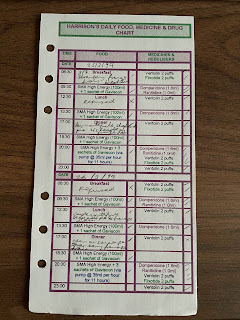
Harrison's feeding, medicine and appointment regime was relentless. I've already hinted at this in a previous post but here's a glimpse into our life at that time. I had to keep everything in a Filofax to keep me on track. Nowadays, smartphones, apps and the like make everything so much more manageable. Below is a sample of his basic food and medicine chart where I tried to capture his meals and usual medications. Although he was 14 months old according to this page, I found this one still in my Filofax the other day! This was the chart that I used when we were travelling to, at, or on our way home from appointments. It was all transferred to a much more comprehensive sheet where the inevitable additional antibiotics and other ad hoc prescribed medications were detailed, and volumes out were estimated. Keeping these records helped me to give as much information as possible to the doctors and dieticians looking after him. There was no way I could remember everything without writing it all down!


Seeing it here doesn't make it look very time consuming. However, what I haven't recorded was the length of time it took to coax Harrison into eating two thirds of a fromage frais! Breakfast would regularly run into the time for his first 100mls of SMA High Energy milk. This wasn't so much of an issue because that was all given via his feeding tube however, it had to be for a specific amount of time. If we were lucky, we could usually squeeze the milk feed into an hour. It needed to be very slow otherwise the whole feed would come back! In addition to creating extra work for me cleaning everything up, that would be another few hundred calories (and probably some medications) that wouldn't have been absorbed. Switching to the high energy formula was a win on two fronts: 
  • Not quite as stressful trying to get volume into (and remain in!) Harrison because containing 1 1/2 calories per millilitre he needed less of it;
  • It was ready made up and was stored at room temperature, so it became super easy to prepare Harrison's feeds with his demanding schedule. No measuring of powder or cooled boiled water required.
Following each formula feed though, Harrison then had to be restrained and entertained in his highchair for another hour to give his body a chance to hang onto what went in! Can you imagine the disappointment and frustration when you think that you've cracked it but inadvertently allow Harrison freedom a few minutes earlier than you know you should (because his demeanour is showing that he's okay), only to be proved wrong and the carpet, highchair and Harrison's clothes all get another soaking in undigested formula? 
There were surely easier ways for Harrison to tell us that he didn't like our choice of carpet and would prefer a hard floor instead! So by now, we're at 10:30am and depending on how optimistic I was feeling, I may or may not have dressed Harrison prior to that feed!

The feeding and medication routine was priority 24 /7 and the rest of our lives had to fit around it. The mandatory weigh-ins three times a week plus the daily weight checks when in hospital, meant that we soon needed additional pages added to the weight section of Harrison's red book.

Sleep for us continued to be a luxury because we had to go to bed late and get up during the night to tube feed Harrison. Those first few weeks of having a new baby and feeding through the night dragged on for months because he was unable to tolerate a 'normal' volume of feed in one sitting. We'd experienced countless stays on the children's ward and every night I'd ask the night staff to wake me at specific times so that I could tube feed Harrison. One night, a very perceptive nurse asked why I didn't use a feeding pump. I had no idea what she was talking about! She left the room and returned with my life saver! An electronic pump that the staff could set up and programme to deliver Harrison's overnight feeds without waking me up!! I felt like I'd won the lottery! From then on, night times in hospital were far more pleasant and I started to feel human again. Obviously, that all went out the window if Harrison was unwell or deteriorated during the night.


Even in the short period of the first few months of Harrison's life, caring for a sick baby was extremely exhausting and I was completely burnt out. We didn't qualify for help from social services because we appeared to be coping. That was so far from the truth. I was existing and floundering aimlessly in a foggy cloud from one day to the next. Things first came to a head  during one of Harrison's almost fortnightly inpatients stays in our local hospital when he was about six months old. For a few weeks we'd been trying a more frequent feeding regime which as I mentioned previously, took around an hour at a time. This was relentless day and night and came to a head when I passed out from exhaustion on the ward. The impression everybody had that I was coping was clearly wrong. The nursing staff immediately took charge and sent me home for bed rest. I hadn't spent a single night apart from Harrison since he was born. I initially resisted but knew I needed a break. The staff assured me that Harrison would be assigned a personal nurse who would step into my role until I was fit to resume, and then they banned me from the ward for three days to enforce me to rest. I only managed one! Even just 24 hours rest had a massive impact on my ability to cope again. There was no protocol for this support, the nurses were just responsive to my needs. 
A few months later a similar situation occurred when the nursing community team came to do their bi-weekly check on Harrison at home. I happened to be in the kitchen preparing his feed but I could barely stand up as I was so tired. Again, they sent me upstairs to rest and although they were only supposed to be with me for about 20 minutes, they stayed for three hours until my husband got home from work and could take over from them. 
After that, the team took it upon themselves to organise a rota of two hourly respite once a week for me, in their own time. Although we didn’t qualify as a family, it was obvious that I needed help. Our local nursing team have been more than just carers for Harrison; they cared for our whole family.


Sunday, 9 January 2022

24 years young!

How did that happen? Surely I'm not old enough to have a 24 year old?! Even he's feeling his age. His main concern today was that he's not going to be able to tick the 16 - 25 age box on forms for much longer!! 

On a more serious note though, I discovered today how much Harrison values people acknowledging his birthday just by a simple message. He's not after lavish gifts, just a simple 'happy birthday' means the absolute world to him.  He's really feeling isolated now (day 668 of shielding) and said that it didn't feel like his birthday because we've not been able to celebrate properly for the past 2 years. He thought that reading his Facebook birthday messages would cheer him up a bit. However, I wasn't planning to post to let people know that it was his birthday. So when he looked, nobody had posted on his timeline. I'm so glad that he told me that he was going to check Facebook otherwise I'd still be none the wiser and he'd have been upset all day but wouldn't have said why. I felt dreadful, so I posted in the hope that a few people would notice  and would maybe leave him a birthday greeting. 

I have the most amazing friends! Harrison ended up with over 60 messages, not only on my Facebook post but also sent directly to him. When he saw the messages beginning to flood in, he visibly lit up and started beaming. His day was further improved with phone and FaceTime calls with four family members and then to top it off, he thrashed Bernard and me in a family Wii session! I won't mention that I accidentally won the bowling match (he wasn't impressed about that!) but I more than made up for that faux pas by not scoring a single point in our basketball game! I had absolutely no idea how to pass the ball or score but didn't mind one bit. 

As we sat and chatted on his bed this evening, Harrison said that he'd had a lovely day after all but would have liked to have been able to go to a restaurant. I was so grateful to my lovely friends who helped to make him feel special.

Here's a record of Harrison's day in photos:


Saveloy hotdog, chips and coleslaw - the requested birthday lunch!

A chilly post lunch walk around the garden


Ooops! Sorry Harrison!


Smoked salmon and scrambled eggs on a muffin accompanied by a slice of Flake birthday cake!